











Frequently asked questions
How does a dual form work?
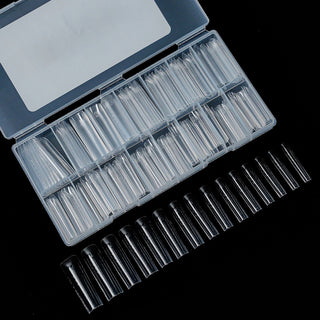
It is a reusable mould. Poly gel or builder gel is spread inside the form, the form is pressed onto the prepped nail, the gel is cured through the clear plastic, and the form peels away leaving a shaped extension that only needs refining. That makes an extension service faster and more consistent than sculpting from scratch, which is why it suits both a tech who is still learning and a busy station. The limit is that the form decides the shape, so a client who wants something in between is better served by sculpting.
Why does every tray have 15 sizes?
Because a client book needs a range even though one hand does not. Thumbs sit at the wide end and little fingers at the narrow, and across different clients the spread is wide. Size all ten forms before any gel is opened and check that each meets both sidewalls without pinching: a form one size too wide leaves a gap that fills with gel and lifts, and one size too narrow pinches the sidewall and becomes uncomfortable within a day.
Clear or matte forms?
Clear for most work, because the lamp cures through them and the tech can see air pockets before curing, which prevents the most common faults. The matte pointed almond gives the underside of the extension a soft texture rather than a gloss, which some techs prefer as a key for the top coat and others use to disguise small imperfections. A station buying one tray to start with should take the clear.
How long does a tray last?
As long as the forms stay clean and unscratched, since they are reusable rather than disposable. Wipe each form with alcohol after use, never file against it, and discard any form with cured gel stuck inside, because that residue transfers to the next nail. Keep the tray closed so dust does not settle in the moulds. Most salons replace a tray when the few sizes they use most have gone cloudy, long before the rest of the tray is worn.
What is on the dual form page
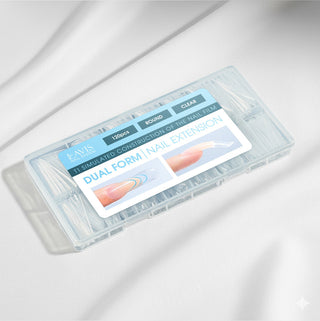
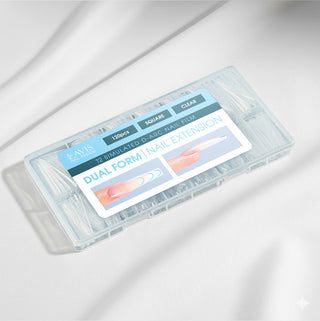
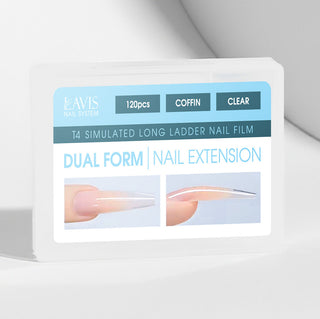
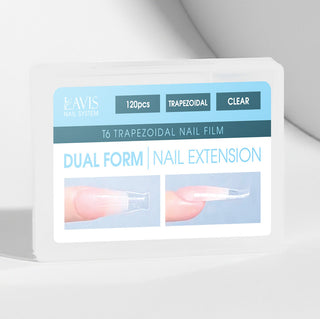
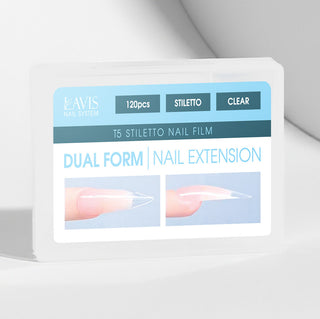
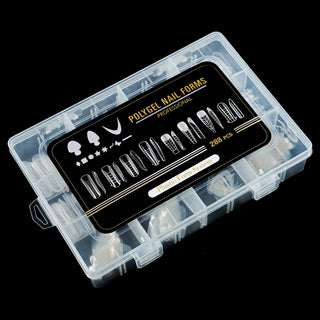
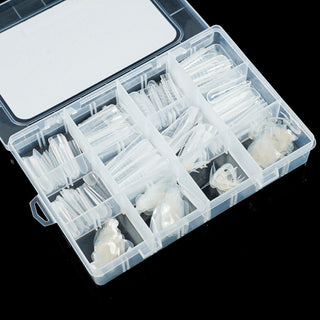
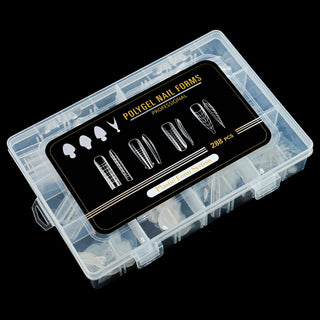
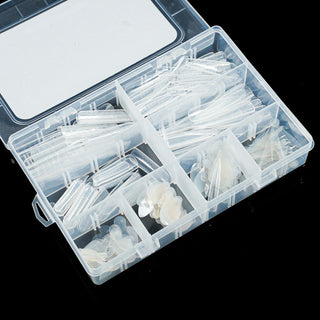
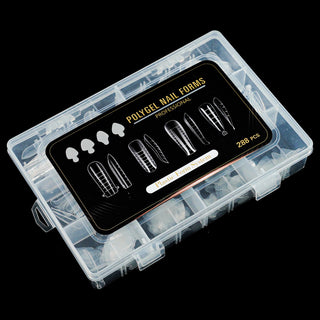
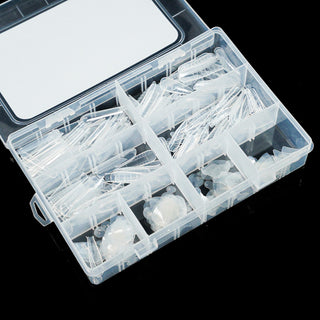
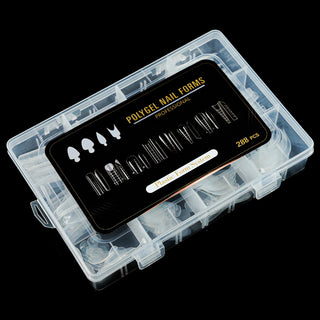
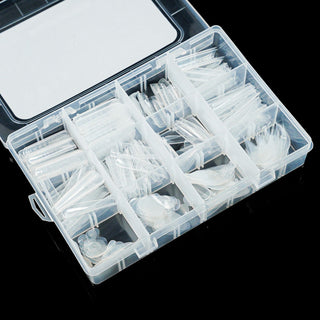
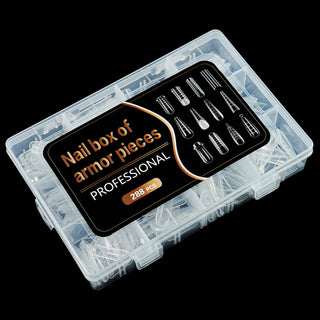
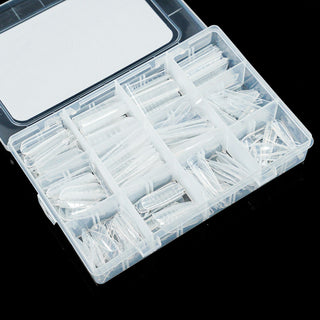
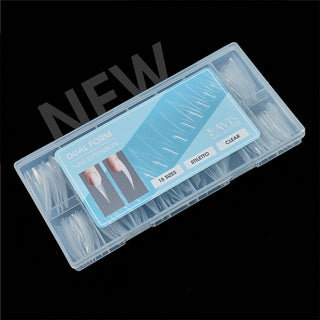
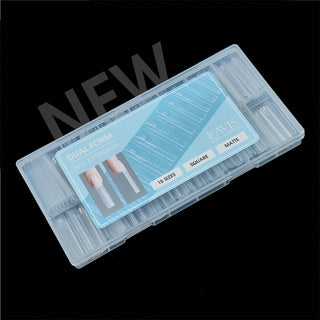
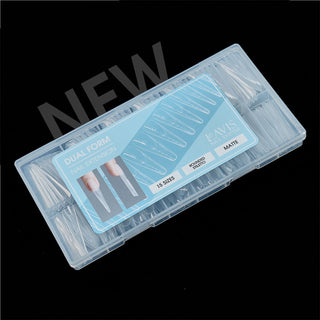
25 dual form listings at wholesale, and unusually for a tool page every one of them is in stock as this page was written. LAVIS supplies 24 and there is one TAYE double-head form. Each form comes as a tray of 15 sizes, and the range covers the six shapes a salon actually books, plus a five-shape kit for a station that wants all of them and a small group of sandwich moulds for shaped and textured work.
The shapes in the range
| Shape | Finish | What it builds |
|---|---|---|
| Square | Clear | The straight-edged set, and the easiest shape for a tech to learn on |
| Tapered square | Clear | A square that narrows slightly, which flatters a wide nail bed |
| Oval | Clear | The soft everyday shape, short or medium length |
| Pointed almond | Clear and matte | The most requested shape of the last few years |
| Long almond | Clear | The same shape with more length for a client who wants it |
| Stiletto | Clear | The sharpest point, for statement sets |
| Sandwich moulds | Clear | Shaped moulds such as the armor and dog-breed designs for textured sets |
| Five-shape kit | Clear | Pointed almond, stiletto, square, oval, and tapered square in one box |
What a dual form actually does
A dual form is a reusable mould. Poly gel or builder gel is spread inside it, the form is pressed onto the prepped nail, the gel is cured through the plastic, and the form peels away leaving a shaped extension that needs only refining rather than sculpting from scratch. That changes the economics of an extension service: a tech who is still slow with a brush can produce a consistent set on a form, and a seasoned tech can do a full set in a fraction of the time a sculpted acrylic would take.
The trade is that the form decides the shape. A client who wants something between an almond and an oval is better served by a sculpted set, and a badly fitted form gives a nail that looks moulded rather than made.
Sizing, which is where most sets are won
Every tray holds 15 sizes because a hand needs a range: a thumb and a little finger are rarely more than a couple of sizes apart on the same client, but across a client book the spread is wide. Size before any gel is opened, lay the ten forms out in order, and check that each one meets both sidewalls without pinching. A form that is one size too wide leaves a gap that fills with gel and lifts; one size too narrow pinches the sidewall and is uncomfortable within a day.
A dual form set, step by step
- Prep and size. Push back, buff the shine off, dust, dehydrate, then size all ten forms before opening any gel.
- Fill the form. Spread poly or builder gel inside it, thicker at the apex and thin at the edges, with no air pockets.
- Place and press. Seat the form at the cuticle line at the angle the nail should follow, press down, and check the profile from the side.
- Cure through the form. Follow the gel's cure time; a thick apex benefits from a flash cure first.
- Peel and re-cure. Remove the form, check the seal at the cuticle, and cure the exposed surface again.
- Refine. File the shape and the underside, buff the surface, then finish with a top coat or colour.
Where dual form sets go wrong
- Wrong size. The single biggest cause of a set that lifts at the sidewall in the first week.
- Air in the gel. A bubble under the form cures as a hollow that shows when the surface is filed.
- Too much gel at the cuticle. It squeezes out when the form is pressed and has to be cleaned before curing.
- No apex. A flat nail built on a form breaks at the stress point regardless of the product.
- Peeling the form too early. An undercured extension distorts as it comes off the mould.
Clear or matte, and why it matters
Most forms here are clear, which lets the lamp cure through them and lets the tech see air pockets before curing. The matte pointed almond is a different proposition: it gives the underside of the extension a soft texture rather than a gloss, which some techs prefer as a key for the top coat and others use to hide small imperfections. If a salon is buying one tray to start with, the clear is the more useful, because seeing through the form is what prevents most of the errors above.
Reusable, and how long they last
Dual forms are reusable rather than disposable, which is what makes them cheap per set. They last as long as they stay clean and unscratched: wipe each form with alcohol after use, never file against it, and discard any form that has cured gel stuck to the inside, because that residue transfers to the next nail and shows as a rough patch. Keep the tray closed so dust does not settle in the moulds, and replace a tray when the sizes a salon uses most have gone cloudy, which happens long before the rest of the tray wears out.
Forms against tips and sculpting
A salon has three ways to add length, and they are not interchangeable. A soft gel or press-on tip is pre-shaped and glued on, which is the fastest option and the least adjustable. A dual form builds the extension from gel in a mould, so the shape is fixed by the tray but the thickness, apex, and length are decided by the tech. Sculpting on a paper form gives complete control and takes the longest to learn. Most salons end up running two of the three: tips for speed and forms for the sets clients book by shape.
The reason forms sit in the middle is removal. An extension built on a form in soft gel or poly soaks or files off like any gel, where a sculpted acrylic has to be filed back and a glued tip has to be released. For a client who changes her mind about length every few months, that matters more than the twenty minutes saved at the appointment.
Aftercare that keeps a form set on
- Cuticle oil daily, which keeps the seal at the cuticle flexible rather than brittle.
- Gloves for cleaning, because water under a lifted edge is what turns a small lift into a rebuild.
- File rather than pull any catch or snag, and book a repair rather than leaving it.
- Rebalance every two to three weeks, which is when the apex is corrected as the nail grows out.
- Never pry a set off. Removal is a soak or a file-back depending on the gel used.
Which shapes a salon needs
Two trays cover most books: an almond and a square or tapered square. Oval is the third, stiletto the fourth, and the sandwich moulds are a specialty purchase for a salon that promotes textured or shaped work rather than a general-purpose tool. The five-shape kit is the sensible first order for a station starting from nothing, because it removes the guess about which shapes the clients will actually ask for, and the individual trays are then bought to deepen whichever shape turns out to be busiest.
Pricing a form set on the menu
A form set sits between a gel manicure and a sculpted acrylic in both time and price, and it should be listed as its own service rather than as an add-on. Two lines work: a full set, and a rebalance at two to three weeks. Where a salon also offers colour or art over the extension, that is a third line rather than something absorbed into the first. Clients understand length as a separate service, and pricing it that way keeps the diary honest when a booking turns into a longer appointment than the slot allowed.
Wholesale pricing at ND Nails Supply
Every tray on this page ships at wholesale pricing for everyone, with no business license, no minimum order, and no membership fee. Free shipping on orders $100+, and in-stock trays ordered before 2pm PT on weekdays leave the same day.