


Frequently asked questions
Is Gelish Foundation Flex a builder gel?
It sits at the base-coat end of that family. Foundation Flex is a rubber base: it builds volume, levels ridges, covers a discolored plate, and cures flexible so a weak nail bends instead of snapping. What it does not do is add length. A client who wants extensions needs a tip, a form with a builder or hard gel, or a poly gel, and asking a rubber base to do that work gives a thick nail that still breaks. Used for what it is, it is the bottle for the client whose gel manicure never lasts.
How is it applied?
After normal prep, a thin bonding coat over the plate with the free edge capped, cured 30 seconds, then a fuller second coat guided so slightly more product sits over the stress area to form a low apex, cured another 30 seconds. From there it takes gel color and a top coat, or just a top coat for a bare strengthened manicure, or a top coat and then lacquer if the client wants polish. Two thin coats matter: a thick coat cures fast and releases heat, which is what a client feels as a spike in the lamp.
Which of the four shades should a salon stock?
Clear first, since it is the ridge-filling strengthening base under any color and is invisible as it grows out. Then one tinted shade matched to the majority of the client book: Light Pink for a tinted natural manicure or as the bed under a French white, Light Nude for the bare rubber-base manicure on fair to medium skin, and Cover Beige to hide a discolored or uneven plate and for the bare nude manicure on deeper skin tones. Most salons run Clear plus one tint rather than all four.
How is Foundation Flex removed?
It soaks off. File the shine off the surface so acetone can get in, wrap with an acetone-soaked pad and foil for about ten minutes, then push the softened gel away with a wood stick instead of scraping. If it does not move, wrap it again rather than forcing it, because most of the plate damage clients blame on gel comes from removal rather than wear. Many salons rebalance instead: file the surface back, feather the regrowth line, and lay fresh Flex over the existing layer for two or three cycles.
What is in the Gelish builder gel collection
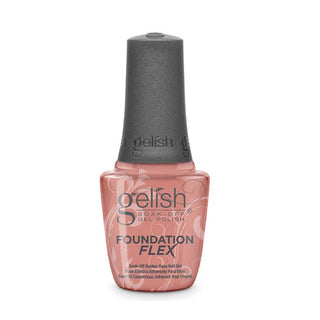
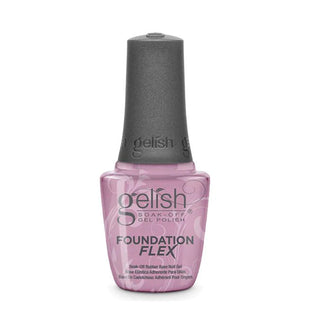
Four bottles of Gelish Foundation Flex at wholesale, in Clear, Light Pink, Light Nude, and Cover Beige, two of them out of stock as this page was written. Foundation Flex is a brush-on gel in the standard Gelish bottle, built on what the brand calls Rubber Base Technology: it carries the Foundation adhesion Gelish is known for, and it cures with flexibility rather than rigidity. The brand lists it as made in the USA, 10-free, vegan, cruelty-free, and fortified with vitamin A and biotin, with a bio-sourced light-activated bonder. Each coat cures in 30 seconds.
Foundation Flex against the other things called builder
| Product type | What it is for | Length it can add | Removal |
|---|---|---|---|
| Rubber base such as Foundation Flex | Base coat, ridge filler, volume on an uneven nail, cover on a discolored nail, flexible overlay on a natural nail | None to speak of; it reinforces the nail rather than extending it | Soaks off |
| Builder gel in a bottle or jar | Overlay with a real apex, short extensions over a form or tip | Short to medium | Soaks off or files off depending on the formula |
| Hard gel | Sculpted extensions with structure | Medium to long | Files off; it does not soak |
| Poly gel | Lightweight extensions worked with a slip solution | Medium to long | Files off mostly |
The question people ask most about this product is whether Foundation Flex is a builder gel. The honest answer is that it sits at the base-coat end of that family. It builds volume, levels ridges, and cocoons a weak nail so it bends instead of snapping, which is what a rubber base does. It is not the product for adding half a centimeter of length over a form, and a salon that buys it expecting a sculpting gel will be disappointed for the wrong reason.
What a rubber base is actually doing
A standard gel base is a thin adhesion layer and nothing more. A rubber base is thicker and stays flexible after it cures, which changes two things on a real client. First, it can be shaped: laid a little heavier in the middle of the nail, it forms a slight apex, so a flat or spoon-shaped nail gets a stronger profile without an enhancement. Second, it moves with the nail. A natural nail bends dozens of times a day, and a rigid layer on top of a bending nail either cracks or lifts at the edges, which is the mechanism behind most of the lifting a salon blames on prep.
That is why this is the bottle for the client whose gel manicure never lasts: nothing about her prep was wrong, the layer on top was simply stiffer than the nail underneath it.
How it is applied
- Prep as usual. Push back, break the shine over the whole plate including the sidewalls, dust, dehydrate, and prime a lifting-prone client.
- First coat thin. A thin bonding layer over the plate, capped at the free edge, cured 30 seconds.
- Second coat with shape. A fuller coat, guided so slightly more product sits over the stress area to form a low apex, cured 30 seconds.
- Then the service. Two thin coats of gel color over the Flex, cured between, then a top coat; or a top coat straight over the Flex for a bare, strengthened manicure; or the Flex topped first and then lacquer if the client wants polish.
- Finish. Cap the edge with the top, cleanse if the top requires it, and oil the cuticle.
Which of the four bottles to open
- Clear. The default and the first bottle to buy. It is the ridge-filling, strengthening base under any gel color, and it is invisible as it grows out.
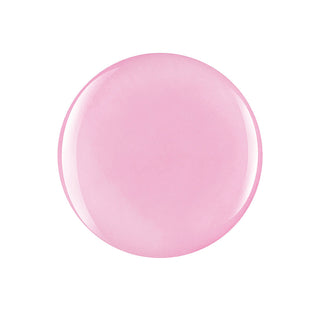
- Light Pink. Worn bare under a top coat for a tinted natural manicure, or as the bed under a French white.
- Light Nude. The bare rubber-base manicure on fair to medium skin, which is the service a client books when she wants to look groomed with no color.
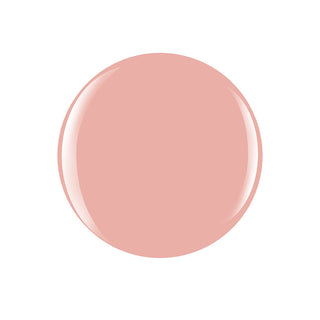
- Cover Beige. Hides a discolored or uneven plate under a sheer color, and is the bare nude manicure on deeper skin tones.
- The pair most salons keep: Clear plus one tinted shade matched to the majority of the client book.
Who this bottle is for, and who it is not for
It is for the client whose natural nails split, peel, or snap at the free edge, for the client who wants something on her nails that is not obviously an enhancement, and for the salon that wants every gel manicure to flex rather than lift. It is also for the ridge-filling job that a standard base cannot do: an uneven plate levelled by a rubber base looks smooth under color instead of showing every groove through it.
It is not for a client who wants length today. That client needs a tip, a form with a builder or hard gel, or a poly gel, and asking a rubber base to do that work produces a thick nail that still breaks. It is also not a repair for a nail that has already split down past the free edge; that gets a silk or fiberglass repair first, then the Flex over it.
Removal and the rebalance
Foundation Flex soaks off. File the shine off the top surface so the acetone can get in, wrap with an acetone-soaked pad and foil for about ten minutes, then push the softened gel away with a wood stick rather than scraping at the plate. If it does not move, wrap again rather than forcing it, because the plate damage clients blame on gel is nearly always damage from removal rather than from wear.
Many salons rebalance rather than remove: file the surface back, feather the regrowth line, and lay a fresh coat of Flex over the existing layer, which keeps the strengthening effect continuous and is faster than starting over. That works for two or three cycles before the nail is better off stripped back and rebuilt.
Common problems
- Heat in the lamp. A thick coat cures fast and releases heat. Two thin coats, and on a sensitive client, a moment out of the lamp partway through the cure.
- Pooling at the cuticle. The brush was overloaded. Wipe more off the brush and start the stroke a hair away from the skin line.
- Lifting at the sidewalls. The buff did not reach them, so the shine is still there under the product.
- The apex in the wrong place. Look at the nail from the side, not from above; the high point belongs over the stress area, not at the cuticle.
- Color chipping over the Flex. Usually the free edge was capped with the base but missed with the top.
Selling it at the chair
This is an easy service to describe and a hard one to name, because most clients have no word for what a rubber base does. The line that works is the problem, not the product: a client who says her nails peel, bend, or break a week after a manicure is describing exactly what this bottle addresses, and the answer is that the layer going on will move with her nail instead of sitting stiff on top of it. Show her the side profile of the finished nail and the low apex, because that is the visible part.
Two practical notes for the booking. The bare tinted version, Light Pink or Light Nude under a top coat, is a fast appointment and a good entry service for a client who has never had gel, since there is no color to commit to and removal is a soak rather than a file-off. And a client whose nails are genuinely damaged should be booked on a cycle of three or four visits rather than sold one manicure, because the improvement she is paying for is the nail growing out under protection, which takes months rather than weeks.
Where it fits on a Gelish shelf
A Gelish station that already carries pH Bond, Pro Bond, Base Foundation, and a top coat adds Foundation Flex as the fifth bottle rather than as a replacement for any of them. The standard Base Foundation stays for ordinary manicures on healthy nails, because it is thinner, faster, and cheaper per service. Flex comes out for the weak, ridged, peeling, or discolored nail, and for the bare strengthened manicure that a salon can put on the menu as its own service. Keeping both means a tech chooses per client rather than putting everyone through the thicker product.
Wholesale pricing at ND Nails Supply
Gelish Foundation Flex ships at wholesale pricing for everyone, with no business license, no minimum order, and no membership fee. Free shipping on orders $75+, and in-stock bottles ordered before 2pm PT on weekdays leave the same day.